Service · Technical SEO
A slow store loses sales before SEO ever gets a chance.
Technical SEO isn’t just rankings — it’s whether your store loads fast enough to keep the visitor, and clean enough for Google to trust. I fix the technical foundation of health, wellness, and beauty Shopify stores so you keep the traffic you earn and convert more of it.
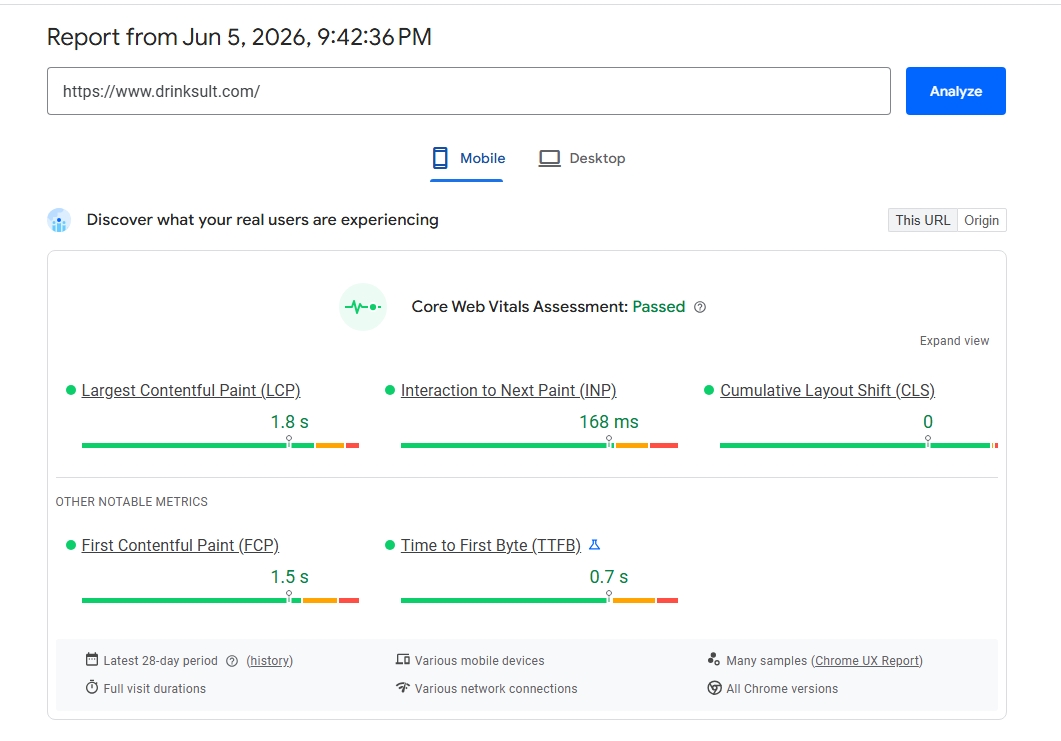
- 95+ mobile Lighthouse
- <1s load time
- 0 render-blocking bloat
This site’s own score — the proof runs on the page you’re reading.
The problem this solves
A “slow site” isn’t a footnote. It’s a revenue leak with an SEO penalty attached.
Most Shopify stores carry a hidden tax: bloated apps, unoptimised images, render-blocking scripts, and a Core Web Vitals score quietly costing them conversions and rankings. Every extra second of load time drops conversion measurably.
And the fix is usually removing things, not adding them. The cheapest wins in most stores are on the removal list — the apps and scripts earning their weight in bloat, not sales.
What I actually do
Faster and cleaner — measured, not promised.
-
Audit the technical stack
apps, scripts, image weight, theme bloat — the removal list is often the cheapest CRO win in the store.
-
Fix Core Web Vitals
LCP, CLS, and INP into the green, on real mobile.
-
Clean the crawl + index picture
structure, schema, canonicals, sitemap — the technical hygiene Google rewards.
-
Connect it to conversion
because faster and cleaner is more sales and more traffic — not one or the other.
-
Keep it maintainable
you (or I, on retainer) can keep it fast after launch.
The proof
This site scores 95+ on mobile Lighthouse and loads in under a second. That’s not decoration — it’s the argument.
A technical-SEO consultant with a slow site is a mechanic who drives a broken car. And on a client store, six weeks of fixes reversed a quiet organic collapse caused by Shopify indexing thousands of duplicate URLs.
How this fits the bigger picture
Often the foundation the other fixes stand on.
Technical health shows up in every CRO Audit, and it lives well as an ongoing retainer — technical debt returns as apps and content pile up. If you’re not sure it’s your bottleneck, the audit maps it against everything else so you fix in the right order.
Start with the CRO AuditThe engagement
Project $1,000–3,000 ·
or retainer $1,500–3,000/mo
A one-off fix, or ongoing health check as the store grows.
What you’re buying is retained traffic and recovered conversions — measured, not promised. One honest note: I’ll never guarantee a ranking. Anyone who does is selling you something they can’t deliver.
Questions
Before you book.
Is this content SEO or technical SEO?
Technical. I fix the foundations - crawlability, indexing, duplicates, speed, structured data - that determine whether your content can rank at all. I'll happily advise on content strategy, but my specialism is the technical layer most agencies skip.
How fast will I see results?
Technical fixes take effect as Google re-crawls and re-indexes - typically you'll see movement within weeks and fuller recovery over a few months. I set up monitoring so we track the recovery in real data, not hope.
Do you work alongside my existing SEO agency?
Often, yes. I handle the Shopify-specific technical work many generalist agencies aren't set up for, and hand off clean foundations for their content and link work to build on.
Will you need access to my store and Search Console?
Yes - collaborator access to the Shopify admin and Search Console. I'll tell you exactly what permissions I need and why, and nothing more.
My traffic dropped for no obvious reason. Can you find the cause?
Usually, yes — and it's rarely a mystery once you read the data. Most "unexplained" Shopify declines trace to defaults nobody managed: thousands of duplicate URLs eating crawl budget, paginated pages splitting ranking signals, or a slow template throttling crawl rate. The investigation phase is built to surface exactly that, with evidence.
What's the deal with Shopify duplicate URLs specifically?
Out of the box, Shopify spawns crawlable duplicates — products under multiple collection paths, filter and sort parameters, paginated variants — that fragment your authority and waste the limited crawl budget Google gives you. A lot of technical SEO on Shopify is canonicalising and controlling those defaults so signals point at the pages that should rank.
How is this different from installing an SEO app?
Apps automate surface-level tasks — meta tags, a sitemap, basic redirects — and stop where the real problems start. They won't diagnose crawl-budget waste, fix parameter duplication, or untangle indexing drift. This is hands-on technical work informed by your actual log and coverage data, not a plugin running a generic ruleset.
What is AEO/GEO, and do I need it?
Answer Engine and Generative Engine Optimisation — being found and cited by AI engines like ChatGPT, Perplexity, and Google's AI Overviews, not just classic search. Much of the same technical hygiene (clean structure, structured data, crawlability) makes you legible to those engines too. As buyers increasingly ask AI before they search, it's becoming hard to ignore.
How do you prove the work actually moved the needle?
Before/after evidence from Search Console and your analytics — indexed pages, impressions, clicks, and rankings tracked through the recovery. Technical SEO is verifiable, so I confirm recovery in real data rather than asking you to assume the fixes worked.
Will any of these changes risk my current rankings?
Handled correctly, no — they protect and improve them. Canonicalisation, redirects, and structured data are implemented carefully and verified against the crawl. I've done migrations and clean-ups with zero rankings lost; the risk comes from doing this carelessly, which is exactly what the priority-ordered, verified process avoids.
Does site speed actually affect SEO, or just conversion?
Both. Crawl rate is partly a function of how fast your server responds, so a slow store gets crawled less and indexed slower. Core Web Vitals are a ranking signal in their own right. Speed work pays off twice — once in rankings, once in conversion — which is why theme performance and SEO reinforce each other.
I'm on Shopify — isn't SEO handled for me?
Shopify is excellent at commerce and careless about crawl budget. It gives you the basics and leaves the costly defaults — duplicate URLs, parameter sprawl, thin auto-generated pages — switched on. "Handled for you" gets you to baseline; being genuinely findable takes un-doing the defaults that were never meant for a brand serious about organic growth.
How do you stop the problem coming back?
Beyond fixing what's broken, I set up Search Console monitoring so the next indexing problem is caught in days, not discovered a quarter later when revenue dips. The goal is a store that stays technically healthy, not a one-time clean-up that quietly decays.
Direct access to the expert
Let's check your store's speed and technical health.
Send me your store and I'll read the technical foundation — the bloat, the Core Web Vitals, the crawl picture — and what fixing it is worth in traffic and conversion. No guaranteed rankings, just the honest read.