Shopify CRO consultant. When the traffic arrives and the orders don’t.
You’re paying for the visits. They land, they look, they leave — and the reporting tells you the conversion rate without telling you where it went.
I find where, fix it, then measure whether it moved.
Five places money leaks between the ad click and the thank-you page. Most stores lose it in one.
The whole path
There are five places a Shopify store loses the order. Most people check one.
I go through all five, every time. The leak is usually in one of them, and which one it is isn’t guessable from the outside.
Stage 1
The arrival.
The ad or the search result promised something. The page has to meet it in the first two seconds. A mismatch here looks like an ad problem and isn’t.

Illustrative example — not a client store. Stage 2
The product page.
Can a stranger tell what it is, who it’s for, why this one, what it costs delivered, and what happens if it’s wrong? Five questions. Most PDPs answer two.

Illustrative example — not a client store. Stage 3
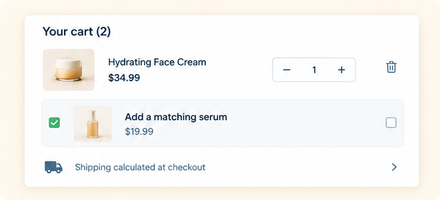
The cart.
Add-to-cart worked, so this stage gets skipped in most audits. It shouldn’t. Shipping costs appearing late, a quantity stepper that fights a thumb, an upsell that interrupts — all of it costs orders at the point of highest intent.
Illustrative example — not a client store. Stage 4
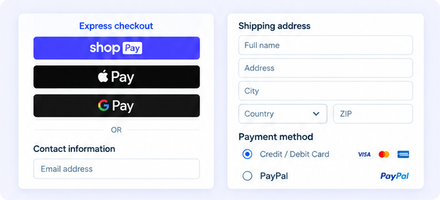
The checkout.
Less of this is yours on Shopify, and the parts that are matter: the fields you added, the payment methods you offer, the gateway you chose, whether express checkout is visible before the form.
Illustrative example — not a client store. Stage 5
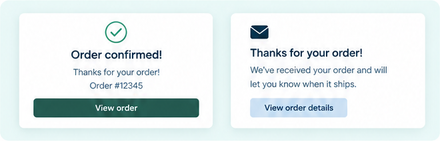
After the order.
Not conversion, strictly — but a confirmation page and an email that do nothing are a repeat purchase you paid for twice.
Illustrative example — not a client store.
The person who finds it is the person who builds it.
This is where most conversion work comes apart. A consultant audits the store, hands over a document, and you go looking for a developer — someone who wasn’t there for the diagnosis, working from a list, guessing at the reasoning behind row four.
I do both halves, which is why the diagnosis is written against what can actually be built rather than against a best-practice list.

Speed and mobile are conversion problems, not technical ones.
Most of your traffic is on a phone. That isn’t a statistic about the internet — check your own analytics, split by device, and you’ll usually find mobile sessions well ahead of desktop and mobile conversion well behind it.That gap is the number worth looking at, and it’s the one a single site-wide conversion rate hides.
Speed matters for the same reason, not because a score looks better. A page that takes four seconds to become useful on a mid-range Android on mobile data is a page a proportion of your paid visitors never see.I measure on real devices rather than on a desktop throttled to look slow, because the two give different answers and only one of them is your customer.
Figure withheld
A conditioned before/after belongs here — the figure, the timeframe, the traffic volume, and what else shipped that month. None is substantiated yet, so the mechanism above ships and the number waits.
Run your own numbers.
Put in your sessions, your conversion rate and your average order value. The calculator shows what a 0.3-point conversion improvement is worth per month — and what you’d have to spend on ads to make the same revenue without touching the site.
It’s arithmetic, not a claim. The numbers are yours and the formula is visible.
At 1.5%, the same traffic produces$1,800more per month.
To make that much from more traffic instead, you’d need about 2,500 more sessions a month — roughly $3,000 in ad spend at a $1 cost per click.
Rough arithmetic, not a forecast. It assumes your average order and your traffic quality hold.
What people ask before they send a store.
How long before I see anything?
The free read comes back in two to three working days. Changes that move a number usually ship inside two to three weeks.
The read is quick because it's one leak, not a full pass. The prioritised plan takes longer — a few days — because going through five stages properly against your funnel data isn't a skim.
Build time depends entirely on what the plan says. A product-page restructure is days. A theme rebuild is weeks. The plan tells you which before you commit to either, which is most of why it exists.
Do you work on the theme, or the apps, or both?
The theme, mostly — and I'll tell you when an app is the problem rather than selling you a theme change.
A lot of what looks like a theme issue is three apps injecting script into the same page. A lot of what looks like an app issue is a theme that was never built for the thing it’s being asked to do.
I look at what's actually loading and what's actually rendering. Sometimes the fix is removing something, and that's a cheaper answer than most vendors want to give you.
My store is on a vintage theme. Is that the problem?
Possibly, and it's worth knowing before you pay for a rebuild.
A dated theme can be genuinely limiting — no sections, no metafield support, markup that fights every change. It can also be perfectly fine and three fixable problems away from converting properly.
Those are very different quotes. The free read will tell you which one you’re looking at, and if it is the theme, that’s its own page.
Will you break what’s working?
I work on a copy of the theme, not on the live one, and I check the full purchase path before anything goes live.
That means a duplicate theme, the changes made there, the whole path walked through on a real phone and a real desktop — add to cart, cart, checkout, payment, confirmation — before it’s published.
That's step six of seven and it's the step that stops a conversion fix becoming an outage.
Can you just tell me what to do and I’ll get my developer to do it?
Yes. That's the $500 plan, and it's written so anyone can execute it.
Every row names the page, the element, the change, what I think it’s worth and what it takes. It isn’t written to need me — if you have a developer you trust, hand it over.
If you’d rather I built it, the $500 comes off the quote. Either way you own the plan.
Do you do the ads too?
No. I work on the store, never the ads.
No creative, no campaign management, no media budgets. The page the ad points at is mine; the ad isn’t.
This is the single most common reason someone and I turn out not to be a fit, so it’s worth being blunt about early rather than three emails in.
Start with the free read.
Send your store URL and roughly how many sessions a month you get. I’ll come back with the biggest leak I can see and why it’s costing you — no call, nothing to pay.
Send your store URL- If you’d rather see the reasoning firstThe seven steps